Best Infant Car Seats for Preemies: What Actually Fits a Baby Under 5 Pounds (2026)
Kadeem · June 12, 2026 · 8 min read
Last reviewed September 24, 2026
This post contains affiliate links — if you buy through them, we may earn a small commission at no extra cost to you. Full disclosure.
When you're preparing for NICU discharge, the car seat stops being a baby-registry checkbox and becomes the last test between your baby and home. Most NICUs won't release a premature baby until they've passed a car seat tolerance test — in the exact seat they'll ride home in. Which means the seat you choose matters more, and earlier, than it does for most families.
This guide is about the seats themselves: which ones actually fit a 4-pound baby, which features matter for a preemie, and what to do if your baby is discharged smaller than your seat's minimum weight.
What Car Seat Fits a Preemie?
The answer is set by weight, because that is the only number that decides it. Most infant seats on the US market start at 4 pounds. A few start at 5. Below 4 the retail list gets very short, and below about 3 there is no car seat at all — that is car bed territory, covered further down this page.
So: at 5 lbs and up, almost any infant seat will do and you should be choosing on harness height and install quality instead. At 4 to 5 lbs, you need a seat rated from 4 and an insert that genuinely fills the shell. Under 4 lbs, the list narrows to the Evenflo LiteMax line, and that is a call to make with your discharge team rather than from a product page.
One caveat nobody mentions. Evenflo has confirmed to car seat technicians that older seats labelled LiteMax or SafeMax can be used from 3 pounds and 15.75 inches, but many of those seats still ship with a label and a manual that read 4 pounds. (The newer LiteMax NXT prints 3 pounds on the seat itself.) Your discharge nurse or CPST reads the sticker on the seat, not the manufacturer's clarification. Check what your actual seat says, and raise any mismatch with the unit well before discharge day rather than on it.
Why the minimum weight on the box actually matters
Every infant car seat has a minimum weight rating — usually 4 pounds, sometimes 5. That number isn't a suggestion. Below it, the harness can't be positioned low and snug enough to restrain your baby safely, and the semi-reclined position can let a small baby's head slump forward and restrict their airway — the same positional apnea the NICU's car seat test screens for.
Plenty of preemies are discharged at 4 to 5 pounds, and some come home smaller. So the first spec to check on any seat isn't the brand or the stroller compatibility — it's the minimum weight and the lowest harness height.
What to look for in a preemie car seat
- A 4-pound minimum weight rating — or lower, which only a few seats offer
- Low bottom harness slots, so the straps can sit at or below tiny shoulders
- An included infant insert that was crash-tested with the seat — never an aftermarket pillow
- A clear recline-angle indicator, since the safe semi-reclined angle is exactly what the car seat test checks
- A lighter carrier — you'll be hauling it through hospital corridors before it ever clicks into a stroller
One rule worth repeating from the NICU: only use inserts and padding that came in the box with your seat. Aftermarket head supports and strap covers aren't crash-tested with the seat and can compress in an impact. If your baby needs extra support, your NICU team will show you how to do it with rolled receiving blankets placed outside the harness — never under or behind your baby.
Chicco KeyFit 30: the seat most NICU families go home with
Ask a room of preemie parents what seat they went home with and the KeyFit comes up more than anything else. The minimum weight is 4 pounds, the included infant insert is genuinely shaped for a small baby, and it's consistently rated one of the easiest infant seats to install correctly — which matters, because a perfect seat installed badly protects nobody.
Chicco
Chicco KeyFit 30 ClearTex
- 4 lb minimum weight with a removable small-baby insert
- Bubble levels and SuperCinch LATCH make a correct install hard to get wrong
- Low harness slots fit small shoulders properly
- Widely compatible with strollers for when your baby graduates
We may earn a small commission — at no extra cost to you.
Graco SnugRide 35 Lite LX: the budget pick that still fits 4 pounds
If the KeyFit stretches the budget, the SnugRide 35 Lite LX is the seat to look at. It's rated from 4 pounds with soft knit inserts that hug a small baby, and the carrier itself is one of the lightest in its class — a real consideration when you're recovering from delivery and walking NICU hallways every day.
Graco
Graco SnugRide 35 Lite LX Infant Car Seat
- 4 lb minimum weight with snug knit infant inserts
- One of the lightest carriers in its class
- Simple, reliable install with LATCH
- Costs meaningfully less than premium seats with the same minimum weight
We may earn a small commission — at no extra cost to you.
Evenflo LiteMax with SensorSafe: the lowest-minimum option
If your baby is coming home under 4 pounds, the list gets short fast. The Evenflo LiteMax line is the one car seat technicians point to: Evenflo has confirmed these seats can be used from 3 pounds and 15.75 inches, and the line was designed and tested with preemies and low birth weight babies in mind. As above, check what the label on your actual seat says — the newer LiteMax NXT is labelled from 3 pounds, but many older LiteMax seats still print a 4-pound minimum, and that is the number the unit will go by. SensorSafe versions add a smart chest clip that alerts your phone if the clip comes unbuckled or the back seat gets too warm. For a baby this small, make the choice together with your discharge team.
Evenflo
Evenflo LiteMax NXT Preemie Car Seat (SensorySoothe)
- The lowest minimum in the mainstream market — the LiteMax NXT is labelled from 3 lbs and 15.7 inches
- SensorSafe chest clip sends phone alerts for unbuckling and temperature
- Lightweight carrier for its size class
- Designed and tested with preemies and low birth weight babies in mind
We may earn a small commission — at no extra cost to you.
Your seat has to pass the test too
Before discharge, your NICU will run a monitored 90–120 minute trial of your baby sitting in your actual car seat, watching oxygen levels, heart rate, and breathing. Bring the seat you bought — not a loaner, not a floor model. We wrote a full guide to the preemie car seat test — what it checks, who needs it, and what happens next.
If your baby doesn't pass on the first try, that's more common than you'd think and usually means a retest a few days later as they mature. Babies who can't yet tolerate a semi-reclined seat may go home temporarily in a car bed — a flat, crash-tested alternative your discharge coordinator can arrange, sometimes covered by insurance.
Getting the fit right on a very small baby
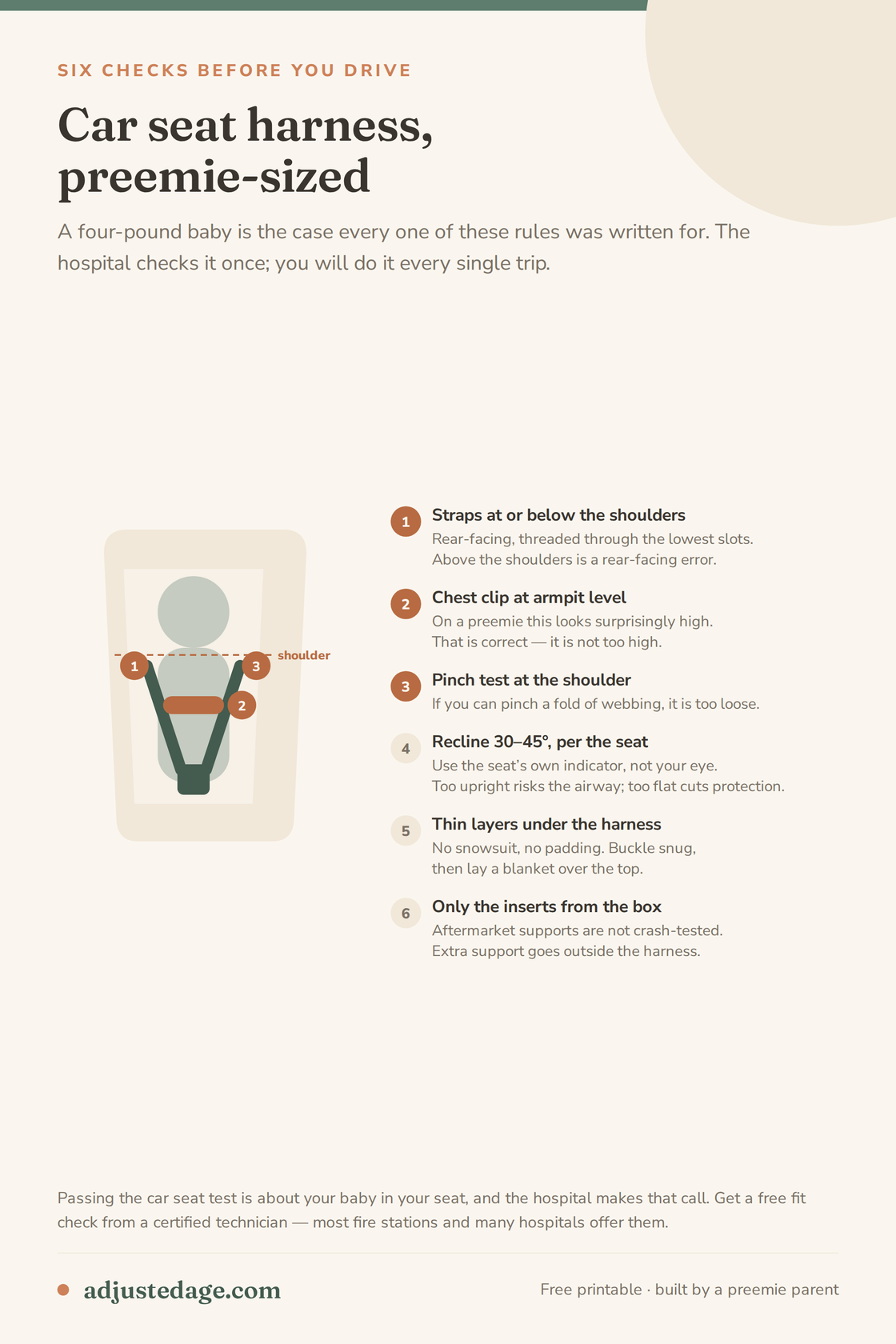
- Harness straps at or just below the shoulders (rear-facing), threaded through the lowest slots
- Chest clip at armpit level — on a preemie this looks surprisingly high, and that's correct
- Pinch test: if you can pinch a fold of harness webbing at the shoulder, it's too loose
- No puffy clothing or blankets under the harness — dress baby in thin layers, buckle snug, then tuck a blanket over the harness
- Recline angle set exactly per the seat's indicator — too upright risks airway slump, too reclined reduces crash protection
A certified child passenger safety technician (CPST) will check your installation for free at many fire stations, hospitals, and inspection events — find one through NHTSA. Many NICUs have a CPST on staff; ask before discharge day so there's time to fix anything.
If Your Baby Can't Ride in a Car Seat: Car Beds
Some babies fail the car seat tolerance test. Some are too small, or too medically fragile, to sit semi-reclined at all. Those babies go home lying flat, in a car bed — a restraint that straps across the back seat and holds the baby fully horizontal instead of at an angle.
A car bed is a prescription, not a shopping decision. A doctor determines medical necessity, usually after an angle tolerance test on the unit, and the hospital arranges it from there. The two models in general use in the US are the Cosco Dream Ride SE (5 to 20 lbs) and the Merritt Hope (4.5 to 35 lbs). Insurance sometimes covers one, and many states run a low-income distribution programme — ask your NICU social worker before you buy anything yourself.
It is usually temporary. Most babies who go home in a car bed move to a conventional rear-facing seat within weeks or a few months, once they have the tone and the size to hold their own airway open in a semi-reclined position. Your team retests before that switch — you do not make it on your own.
A note on outgrowing it
Car seat limits go by weight and height, not by age — actual or adjusted. Your preemie will likely use an infant seat longer than a term baby would, and that's fine. (Adjusted age matters for milestones and development — if you haven't yet, try our adjusted age calculator — but the car seat doesn't care about either birthday. It cares about pounds and inches.)
That first drive home — going 15 under the speed limit with someone in the back seat watching a baby the size of a loaf of bread — is one of the strangest, best moments of the whole NICU experience. Pick a seat that fits, let the NICU test it, install it right, and go slow. You've got this. (Still in the packing stage? Here's what to pack in a hospital bag for an early delivery.)
As an Amazon Associate, Adjusted Age earns from qualifying purchases at no extra cost to you.
Common questions
What is the lowest weight an infant car seat can fit?
Most infant car seats have a 4-pound minimum, including the Chicco KeyFit 30 and Graco SnugRide 35 Lite LX. Evenflo's newer LiteMax NXT is labelled from 3 pounds; older LiteMax seats are confirmed by Evenflo for 3 pounds but many are still labelled 4 — check the sticker on the seat you actually buy, because that is the number the NICU will go by. Below the seat's minimum weight the harness cannot restrain a baby safely — babies smaller than that may need a crash-tested car bed instead.
Can a preemie ride in a regular infant car seat?
Yes, as long as the baby meets the seat's minimum weight and passes the NICU's car seat tolerance test — a monitored 90–120 minute trial in your actual seat that checks oxygen levels, heart rate, and breathing before discharge.
What happens if my preemie fails the car seat test?
A failed first test is common and usually just means a retest a few days later as your baby matures. Babies who can't yet tolerate the semi-reclined position may temporarily go home in a car bed, a flat crash-tested alternative your discharge coordinator can arrange.
Can a 4 pound baby go in a car seat?
Yes — in a seat rated from 4 pounds, with the harness in the lowest slots, the chest clip at armpit level, and only the insert that came in the box. The NICU car seat tolerance test confirms your baby can hold their airway open in that position, and it is done in your seat, so bring it in before discharge day.
What is a car bed, and when does a preemie need one?
A car bed is a restraint that straps across the back seat and holds a baby fully horizontal instead of semi-reclined. It is prescribed when a baby fails the car seat tolerance test, or is too small or too medically fragile to sit at an angle. A doctor determines medical necessity and the hospital arranges it. The two models in general US use are the Cosco Dream Ride SE (5 to 20 lbs) and the Merritt Hope (4.5 to 35 lbs).
What if my baby is discharged smaller than the car seat's minimum?
Do not use the seat under its rating, and do not improvise padding to make it fit. Tell the team — this is a common situation and they handle it routinely, usually with either a few more days of growing or a car bed.
How long will a preemie use an infant car seat?
Longer than a term baby would. Seat limits run on weight and height, never on age — actual or corrected — so a smaller baby stays in the infant seat longer. That is a good thing, not a delay.
Free: The NICU Parent Starter Pack
Three printables in one file: the NICU survival checklist, the preemie clothing size guide, and the paced feeding quick-reference.
No spam. Unsubscribe any time.
Written by
Kadeem · Preemie dad
Kadeem's son was born at 29 weeks and spent 45 days in the NICU. He built Adjusted Age to give preemie parents the answers he wished he'd had.
Not a medical professional. This guide is based on published guidance from sources like the CDC and AAP, and our own experience. Always check with your baby's care team.
Keep reading
Air Purifiers and Humidifiers for Preemies: What Helps During RSV Season (2026)
No air purifier prevents RSV — immunization and handwashing do that. But for preemie lungs, especially after BPD, cleaner and properly humidified air genuinely matters. An honest guide to purifiers, humidifiers, and what to skip.
June 12, 2026
Best Baby Monitors for Preemies: Peace of Mind After the NICU (2026)
After months of NICU monitors, the silent nursery is terrifying. An honest guide to home baby monitors for preemie parents — what they do, what they can't, the 6-lb catch on FDA-cleared features, and how to choose.
June 12, 2026
Best Swaddles and Sleep Sacks for Premature Babies (2026)
Newborn swaddles swallow a 5-pound baby. Here are the swaddles and sleep sacks that actually fit preemies, the safe-sleep rules that matter more after the NICU, and when to stop swaddling.
June 12, 2026