Preemie Clothing Size Chart: Comparing Carter's, Gerber, Perfectly Preemie, and Itty Bitty Baby
Kadeem · June 3, 2026 · 6 min read
Last reviewed September 24, 2026
This post contains affiliate links — if you buy through them, we may earn a small commission at no extra cost to you. Full disclosure.
One of the most disorienting moments in our NICU stay was realizing the 'preemie' onesies we'd bought didn't remotely fit our 29-weeker. They swallowed him whole. When we went back to find smaller options, we discovered that 'preemie' means something completely different depending on the brand — and there's no industry standard.
This guide is the Rosetta Stone I wish someone had handed me. Here's exactly how the major brands size their smallest garments, what NICU-friendly features to prioritize, and what to actually buy based on your baby's current weight.
What Weight Do Preemie Clothes Fit?
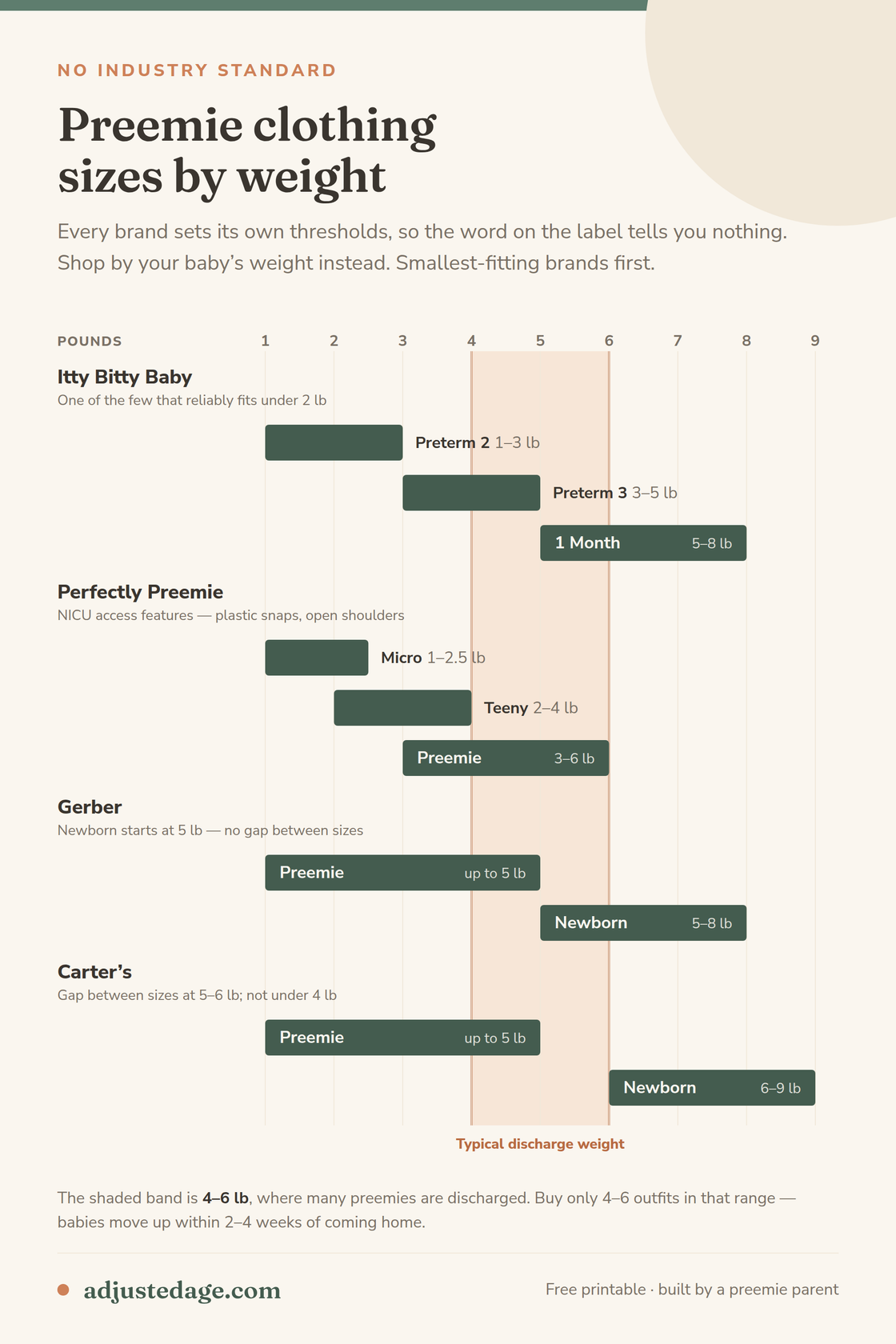
Short answer: most preemie-size clothing is cut for a baby up to about 5 lbs, and roughly 17 inches long — that is where both Carter's and Gerber draw the line. Specialist brands spread the range much wider: Perfectly Preemie's preemie size runs 3–6 lbs, while at the small end Perfectly Preemie's Micro starts at 1 lb and Itty Bitty Baby makes a size for babies under 1 lb. Below about 4 lbs you need a brand that makes a size smaller than 'preemie' at all.
Newborn size starts roughly where preemie ends: 5–8 lbs at Gerber, 6–9 lbs at Carter's — which leaves a 5–6 lb gap at Carter's where neither size is a clean fit. So the crossover sits somewhere in the 5–6 lb range, which is also where many preemies are discharged. That is the whole reason this is so confusing. The size you need on the day you go home lands exactly on the seam between two sizes that two brands define differently.
Why Preemie Sizing Is So Inconsistent
Unlike adult clothing or even standard newborn sizes, there is no regulated industry standard for what constitutes 'preemie' sizing. Each brand sets its own weight thresholds based on their customer base and manufacturing decisions.
The practical consequence: you cannot shop by label. A baby weighing 3 lbs will fit a 'micro' at one brand, a 'preterm 2' at another, and swim in a Carter's preemie, which is cut for babies nearer 5 lbs. You need to know the weight ranges, not the marketing names.
The Master Preemie Size Chart by Weight
Carter's
- Preemie: up to 5 lbs / up to 17 inches
- Newborn: 6–9 lbs / 18–21.5 inches
- Best for: babies in the 4–5 lb range, including late preemies approaching discharge
- Note: Carter's newborn starts at 6 lbs, so a 5–6 lb baby falls between Carter's two sizes — and do not buy Carter's preemie for babies under 4 lbs
Gerber
- Preemie: up to 5 lbs
- Newborn: 5–8 lbs
- Best for: babies in the 3–5 lb range
- Note: Gerber's newborn starts at 5 lbs, right where its preemie ends — so there is no gap between sizes the way there is at Carter's
Perfectly Preemie
- Micro: 1–2.5 lbs
- Teeny: 2–4 lbs
- Preemie: 3–6 lbs
- Best for: NICU use across the full weight spectrum — specifically designed with medical access in mind
- Note: Many styles have open-shoulder snaps for IV lines, plastic closures safe for X-rays, and footless designs for pulse oximeters
Itty Bitty Baby Boutique
- Preterm 1: up to 1 lb · Preterm 2: 1–3 lbs
- Preterm 3: 3–5 lbs
- 1 Month: 5–8 lbs (their next size up — there is no size called 'preemie')
- Best for: extremely low birth weight (ELBW) babies under 2 lbs — one of the few brands that reliably fits at this weight
Preemie vs. Newborn: Which Do You Actually Need?
Buy for the weight your baby is now, not the weight they are heading for. Mainstream preemie fits up to about 5 lbs; newborn picks up at 5 or 6 and runs to 8 or 9. Under 5 lbs, buy preemie. Between 5 and 6 it depends on the brand — Gerber's newborn (5–8 lbs) will fit before Carter's newborn (6–9 lbs) does.
The mistake nearly everyone makes is buying newborn to grow into. On a 4 lb baby, a newborn onesie means fabric bunching under the car seat harness straps and sleeves down over the hands — and the first of those is a safety problem, not a cosmetic one. Four to six things in the size that fits today is enough.
Most preemies move out of preemie size within two to four weeks of coming home, and out of newborn a month or so after that. Nothing bought at this stage gets worn for long, which is an argument for buying few rather than buying big.
NICU-Friendly Features: What to Actually Look For
Sizing is only part of the equation. For a baby in the NICU, the clothing needs to work alongside medical equipment without creating barriers for the nursing staff. Here's what matters:
- Plastic snaps (not metal) — Metal snaps show up on X-rays and can obscure the image. Any garment worn in an active NICU should have plastic snaps only.
- Open-shoulder or snapped shoulder designs — Allows IV line placement and PICC line access without removing the entire garment. Standard pull-over onesies make nursing care significantly harder.
- Footless or fold-over foot options — Leaves feet accessible for pulse oximeters and routine heel stick blood draws.
- Front-opening or full-snap bodies — Makes skin-to-skin contact (kangaroo care) possible without full undressing of a fragile, wired baby.
- Soft natural fabrics — 100% cotton or bamboo blends. Avoid polyester blends for NICU use, and skip anything with raised embellishments or decorative hardware that can irritate delicate preemie skin.
What to Buy and When
For active NICU stays: Start with 2–3 garments that match your baby's current weight. Preemies grow fast once they're past the acute phase — over-buying in any single size is a common and completely understandable mistake that most NICU parents make.
For the transition to home: Discharge is decided by milestones — feeding, breathing, holding their own temperature — not by a set weight, but many preemies go home somewhere around 4–6 lbs. Buy 4–6 outfits for the weight your baby is at as discharge gets close. Expect to move up within 2–4 weeks of coming home.
Budget approach: Mainstream brands (Carter's, Gerber) are good value at the 4–6 lb range. For babies under 3 lbs, specialty NICU brands are worth the cost — mainstream preemie sizes genuinely won't fit and the NICU-friendly design details matter.
A Note on Secondhand Preemie Clothing
For standard preemie and newborn sizes, secondhand clothing from local buy-nothing groups, NICU family networks, or hospital-affiliated donation programs is completely fine and can save significantly. Most families find their preemie clothing lightly used — babies grow through these sizes in weeks.
For specialized NICU garments (IV-access designs, medical snap configurations), buy new to ensure the functional elements — snaps, access points — are intact and in good working order.
Your NICU social worker or family liaison may know of local organizations that donate preemie clothing to NICU families. It's always worth asking. The NICU community takes care of its own.
New to the NICU? Start here: NICU Survival Guide for First-Time Parents
Prefer this as a printable? Grab the free one-page preemie size guide PDF. And for sleep, see the best swaddles and sleep sacks for premature babies — preemie sizing applies there too.
Carter's
Carter's Preemie Bodysuits (Multi-Pack)
- True preemie sizing for babies up to 5 lbs
- Soft cotton multi-pack, so clean clothes are always on hand
- Widely available and budget-friendly while baby grows fast
We may earn a small commission — at no extra cost to you.
Gerber
Gerber Preemie Onesies
- Preemie size runs up to 5 lbs, and Gerber's newborn picks up right at 5 — no gap between sizes
- Simple snap closure for easy diaper changes and monitor access
- Affordable multi-packs for frequent changes
We may earn a small commission — at no extra cost to you.
HALO
HALO SleepSack Swaddle, Cotton — Preemie
- Preemie-sized swaddle for what goes over the onesie at night
- Sleeveless sack design supports back-sleeping safety guidance
- Adjustable wrap keeps up with a fast-growing preemie
We may earn a small commission — at no extra cost to you.
Common questions
What size clothes does a 4 lb premature baby wear?
Sizing varies wildly by brand, but a 4 lb baby generally fits best in Gerber Preemie, Perfectly Preemie's "Teeny," or Itty Bitty Baby's "Preterm 3" sizes. Carter's Preemie is cut for babies up to 5 lbs and is typically too big for babies under 4 lbs.
What clothing features are best for a baby in the NICU?
Look for open-shoulder snaps to accommodate IV lines, plastic closures that are safe for X-rays, and footless designs that allow access for pulse oximeters. Front-opening garments are also essential because they allow for easy kangaroo care without completely undressing a fragile baby.
How many preemie clothes should I buy for the NICU?
Start with just 2-3 garments in your baby's current weight range, as preemies grow quickly once past the acute phase. When preparing for discharge, buy 4-6 outfits for the weight your baby is at as discharge gets close. There is no set discharge weight, but many preemies go home around 4-6 lbs, and most size up within a few weeks of coming home.
What weight do preemie clothes fit?
Most preemie-size clothing is cut for a baby up to about 5 lbs and roughly 17 inches long — that is where both Carter's and Gerber draw the line. Specialist brands spread the range much wider: Perfectly Preemie's preemie size runs 3–6 lbs, while its Micro starts at 1 lb and Itty Bitty Baby makes a size for babies under 1 lb. Below about 4 lbs you need a brand that makes a size smaller than "preemie" at all.
Is preemie size the same as micro preemie?
No. "Preemie" is the retail size — up to about 5 lbs at Carter's and Gerber — and it is what you will find in a store. Micro preemie sizes sit below it and come from specialist brands: Perfectly Preemie's Micro (1–2.5 lbs) and Teeny (2–4 lbs), Itty Bitty Baby's Preterm 2 (1–3 lbs) and Preterm 3 (3–5 lbs). Most stores stock none of them.
What size do micro preemies wear?
Under 2 lbs: Perfectly Preemie Micro or Itty Bitty Baby Preterm 2 — Itty Bitty also makes a Preterm 1 for babies under 1 lb. Between 2 and 4 lbs: Perfectly Preemie Teeny, or Itty Bitty Baby Preterm 2 up to 3 lbs and Preterm 3 from 3 lbs. Many NICUs also supply their own garments for the smallest babies.
Do preemie clothes run big or small?
They run to the brand, not to a standard. Carter's and Gerber both size preemie up to 5 lbs, which will swallow a baby under 4 lbs; below that you need a specialist brand such as Perfectly Preemie or Itty Bitty Baby. Ignore the word on the packet and read the weight range printed under it.
How long will my baby wear preemie size?
Two to four weeks after coming home, for most babies. Preemies tend to gain quickly once feeding is established, and the window for this size is short. Four to six outfits, not a wardrobe.
Can a full-term newborn wear preemie clothes?
Yes, if they are small enough. A full-term baby born under 6 lbs will often start in preemie size. Size here is set by weight and length, not by gestational age.
Free: The NICU Parent Starter Pack
Three printables in one file: the NICU survival checklist, the preemie clothing size guide, and the paced feeding quick-reference.
No spam. Unsubscribe any time.
Written by
Kadeem · Preemie dad
Kadeem's son was born at 29 weeks and spent 45 days in the NICU. He built Adjusted Age to give preemie parents the answers he wished he'd had.
Not a medical professional. This guide is based on published guidance from sources like the CDC and AAP, and our own experience. Always check with your baby's care team.
Keep reading
Preemie Coming-Home Outfits: Real Sizing, Car-Seat Safety, and What Actually Fits (2026)
The "newborn" coming-home outfit swallows a 4-pound preemie — and bulky layers are unsafe in a car seat. Here's realistic preemie sizing, the car-seat-harness rule for the going-home outfit, and the NICU-friendly pieces that actually fit.
June 13, 2026
Best Diaper Bags for NICU and Preemie Parents: Built for Hospital Days (2026)
NICU parents haul pump parts, milk coolers, and twelve-hour-day supplies, not just a few diapers. Here's what makes a bag work for hospital life — and three backpacks that fit the job at every budget.
June 13, 2026
Best Bottle Sterilizers and Drying Racks for Preemie Parents (2026)
For a preemie with an immature immune system, the CDC says sanitize feeding items at least once a day. Here's what that actually requires — plus the sterilizers and drying racks worth owning, from all-in-one machines to a few-dollar microwave bag.
June 13, 2026