Preemie Feeding Guide: From NICU Tube to Home (2026)
Kadeem · May 28, 2026 · 5 min read
Last reviewed September 24, 2026
This post contains affiliate links — if you buy through them, we may earn a small commission at no extra cost to you. Full disclosure.
One of the hardest things about having a premature baby is that something as basic as feeding becomes complicated, medical, and slow. Full-term babies are born knowing how to eat. Preemies have to learn it—and that learning happens on the baby’s timeline, not yours.
Kadeem started Adjusted Age after his son was born at 29 weeks, and the feeding journey—from a tube taped to a tiny cheek all the way to a bottle at the kitchen table—was one of the longest, most emotional roads of the whole NICU stay. Here’s a plain-language map of that journey, so you know roughly what’s coming.
The NG Tube: Your Baby’s Bridge
Before about 32 to 34 weeks gestation, a baby’s brain hasn’t yet developed the maturity to coordinate the “suck-swallow-breathe” reflex. Trying to eat by mouth before then isn’t just hard—it can be unsafe, and it burns precious calories your baby needs for growing.
That’s what the nasogastric (NG) tube is for. It’s a thin, soft tube that runs through the nose down to the stomach, delivering milk directly so your baby can sleep, heal, and put every calorie toward growth instead of the exhausting work of eating. It looks alarming at first. It is actually a gift—a bridge that carries your baby until their body is ready to do the work itself.
Fortifying Breast Milk: What the 2026 Guidelines Say
In 2026, the American Academy of Pediatrics (AAP) again reaffirmed that mother’s own milk (or pasteurized donor milk when needed) is the ideal foundation for premature infants. Breast milk is uniquely protective for fragile preemie guts.
But here’s the part that surprises a lot of parents: for very low birth weight babies, the guidelines are clear that human milk usually needs to be fortified. A premature baby has the aggressive caloric and mineral needs of a fetus who should still be growing inside the womb—and plain breast milk alone often can’t keep up with that demand. Fortifier adds the extra calories, protein, and minerals your baby needs to grow on the steep curve they’re supposed to be on. Needing fortifier is not a failure of your milk. It’s math.
Transitioning to Breast and Bottle
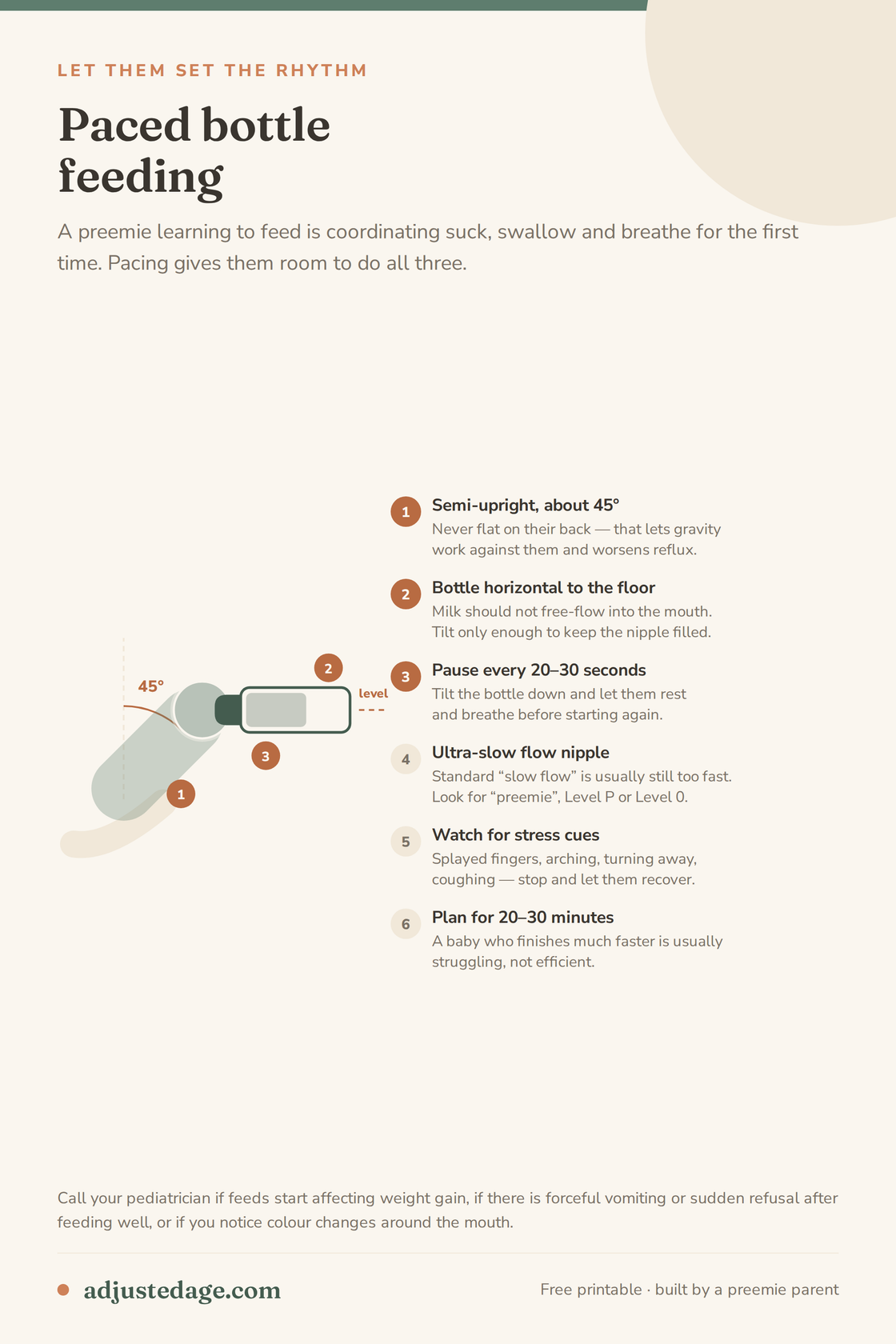
The modern NICU runs on cue-based feeding. Instead of forcing a feed on a rigid clock, nurses watch for readiness cues—rooting, waking naturally, bringing hands to mouth, staying alert and calm. Feeding when the baby signals readiness teaches them that eating is a positive, self-directed experience rather than something that happens to them.
You’ll also hear the term “nipple confusion.” Here’s the honest version: it’s usually flow preference. A preemie will gravitate toward whatever takes the least energy. A fast bottle can make the harder work of nursing frustrating by comparison. Good NICUs combat this with slow, preemie-flow nipples and by encouraging “dry nursing”—letting the baby practice at a freshly pumped (nearly empty) breast so they learn the mechanics without being overwhelmed.
Going Home on a Schedule
When you finally get to take your baby home, you’ll likely be sent off with a strict, round-the-clock feeding schedule—usually every three hours, day and night. This catches new parents off guard: shouldn’t you feed on demand?
For preemies, often no—at least at first. Premature babies frequently lack the energy reserves to wake themselves up when they’re hungry. If you waited for them to demand a feed, they might sleep through meals they genuinely need to grow. So you wake them, on schedule, until your pediatrician says they’ve earned the right to sleep and self-regulate. It’s exhausting. It’s also temporary.
A Few Things That Helped Us
- Write everything down. Volumes, times, diapers. In the fog of those weeks, your notes are more reliable than your memory—and they’re gold at pediatrician visits.
- Celebrate the tube coming out like the milestone it is. Going from NG tube to full oral feeds is one of the biggest “going home” gates.
- Ask about a feeding therapist. Occupational and speech therapists who specialize in infant feeding are wizards. If your baby is struggling, ask for one.
- Protect your own rest where you can. A round-the-clock feeding schedule is a two-person job if you have any help available. Take it.
You Are Not Behind
If your baby is still on a tube while other babies the same calendar age are nursing—your baby is not behind. They’re exactly where a baby born when yours was should be. That’s the entire point of corrected age.
Use our Adjusted Age Calculator to see your baby’s corrected age at a glance. It’s the single best frame for understanding feeding readiness, growth, and milestones—measured against where your baby actually is, not the calendar date on the wall.
If reflux is making feeds harder, read: Best Bottles for Preemies with Reflux: Flow Rate, Paced Feeding, and What Actually Works
The bottles and nipples that made the transition work
Ask your unit what they are using before you buy anything. Coming home with a different nipple than the one your baby has been feeding on is a change you do not need in week one. That said, the hospital will not send you home stocked, and these are the three we ended up using once we were on our own.
A bottle that cuts down swallowed air
Air swallowed during a feed comes back up, and a preemie who is already working hard to coordinate suck, swallow and breathe does not have spare capacity for that. A vented bottle is more parts to wash, which is a real cost at 3am — but it is the trade most of us make in the first months.
Dr. Brown's
Dr. Brown's Options+ Wide-Neck Anti-Colic Bottles
- Internal vent reduces the swallowed air that drives gas and spit-up
- Wide-neck shape works for babies moving between breast and bottle
- The vent insert comes out later, so the bottle gets simpler as they grow
- Same system as the preemie nipples below
We may earn a small commission — at no extra cost to you.
The slowest nipple you can get
Flow rate matters more than the bottle. Too fast and a preemie stops pacing themselves, which is what a choke or a colour change during a feed usually is. Level P — Dr. Brown's Preemie Flow — is the right starting point for most babies coming off tube feeds, and there is an even slower Ultra-Preemie nipple if P still runs too fast for your baby. Move up only when your team or your baby tells you to.
Dr. Brown's
Dr. Brown's Preemie Flow Nipples (Level P)
- Dr. Brown's second-slowest flow and the usual starting point for preemies — an Ultra-Preemie nipple exists if this still runs too fast
- Lets your baby set the pace and stay coordinated
- Fits the Options+ bottles above
- Cheap to stock spares so a clean one is always ready
We may earn a small commission — at no extra cost to you.
If you are protecting breastfeeding
For families going back and forth between breast and bottle, a nipple shaped to encourage the same latch makes the switching less confusing. It also has the fewest parts of anything here, which counts for more than you would think when you are washing bottles eight times a day.
Lansinoh
Lansinoh mOmma Feeding Bottle
- NaturalWave nipple encourages a paced, breast-like latch
- Gradual slope helps a small mouth get a secure seal
- Built-in vent cuts swallowed air
- Fewest parts to wash of anything on this page
We may earn a small commission — at no extra cost to you.
Common questions
Why do preemies need an NG feeding tube?
Babies born before 32 to 34 weeks have not developed the suck-swallow-breathe reflex required to eat safely by mouth. The NG tube delivers milk directly to their stomach so they can conserve energy and use every calorie for growth instead of the exhausting work of eating.
Why does the NICU add fortifier to breast milk?
Premature babies have the aggressive caloric and mineral needs of a fetus still growing in the womb, which plain breast milk alone cannot meet. Adding human milk fortifier provides the extra protein and minerals required to keep them on their steep growth curve.
Do I need to wake my preemie to feed them at home?
Yes, you will likely be sent home on a strict, round-the-clock feeding schedule because preemies often lack the energy reserves to wake themselves when hungry. You must wake them to feed on schedule until your pediatrician confirms they have earned the right to sleep and self-regulate.
Free: The NICU Parent Starter Pack
Three printables in one file: the NICU survival checklist, the preemie clothing size guide, and the paced feeding quick-reference.
No spam. Unsubscribe any time.
Written by
Kadeem · Preemie dad
Kadeem's son was born at 29 weeks and spent 45 days in the NICU. He built Adjusted Age to give preemie parents the answers he wished he'd had.
Not a medical professional. This guide is based on published guidance from sources like the CDC and AAP, and our own experience. Always check with your baby's care team.
Keep reading
Best Pumping Accessories for NICU Moms
When your baby is in the NICU, your breast pump becomes a lifeline—but the accessories around it are what make a demanding pumping schedule sustainable. This guide covers the six most useful accessories for NICU moms, how they fit into a hospital-to-home routine, and what to prioritize if you’re on a budget.
June 2, 2026
Best Bottles for Premature Babies (2026)
Feeding a premature baby is a medical milestone, not just a routine task. This guide explains why bottle choice is different for preemies, what to prioritize in nipples and bottles, and which specific options work best when your baby is still mastering the suck-swallow-breathe reflex.
May 30, 2026
Our Preemie Journey
A dad’s story of his son’s 45 days in the NICU, the fear and waiting of premature birth, and how that experience led him to build Adjusted Age for other preemie parents.
May 14, 2026